[toc]
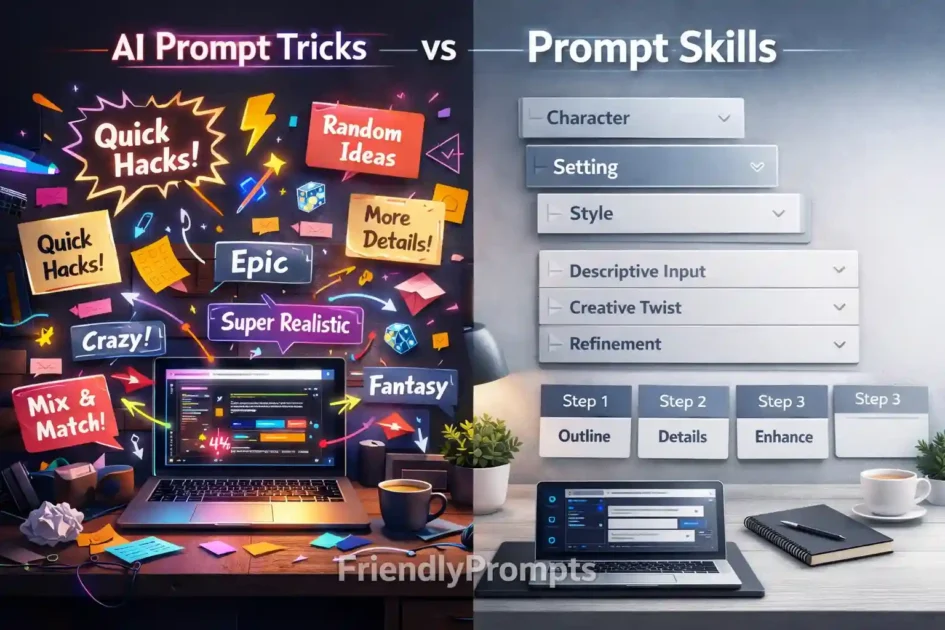
AI Prompt Tricks Vs Prompt Skills: What Actually Works
AI often feels unpredictable because you expect it to think like you do.
You know what you mean. You understand the background. You assume the goal is obvious. The AI does not share any of that context unless you give it explicitly.
This misunderstanding sits at the center of AI Prompt Tricks Vs Prompt Skills.
When you rely on prompt tricks, you hope the model guesses your intent correctly. Sometimes it does. Sometimes it absolutely does not. That is why results swing from impressive to embarrassing with the same tool.
Prompt skills reduce guessing. They replace hope with structure.
Once you understand this, AI prompting stops feeling random and starts feeling mechanical in a good way.
What AI Prompt Tricks Actually Are
AI prompt tricks are shortcuts.
They usually show up as clever phrases, rigid templates, or magic instructions that promise better results with minimal effort.
You have seen them everywhere in ChatGPT prompts.
Act as an expert.
Think step by step.
Write like a professional copywriter.
These tricks are not useless. Let us be clear about that. They can improve output in very specific situations.
The problem in the AI Prompt Tricks Vs Prompt Skills debate is not the existence of tricks. It is dependence on them.
Tricks work when the task matches the original context they were designed for. The moment you change the audience, the goal, or the format, they weaken fast.
That is why people keep collecting prompts instead of understanding them.
It feels productive, but it quietly stalls your growth.
What AI Prompt Skills Really Mean
Prompt skills are not phrases you memorize. They are thinking habits you apply.
This is the part of AI Prompt Tricks Vs Prompt Skills most people miss.
Prompt skills focus on what the AI needs to do a good job, not what sounds impressive to type.
That usually means four things.
Clear intent because vague goals create vague output.
Relevant context because background changes decisions.
Reasonable constraints because unlimited freedom creates chaos.
Defined output expectations because format matters.
When you use prompt skills, you stop asking the AI to pretend. You start giving it instructions it can actually follow.
This approach works across AI prompting tools, not just one model or one interface.
The One Difference That Changes Results
If you remember only one thing from this AI Prompt Tricks Vs Prompt Skills guide, remember this.
Tricks modify wording. Skills shape input.
Tricks try to influence behavior indirectly. Skills design the conditions for good behavior.
That difference sounds small, but it changes everything.
When you rely on tricks, you keep adjusting sentences. When you rely on skills, you adjust information.
Information beats clever wording every single time.
Why Tricks Break Under Pressure
This is where AI Prompt Tricks Vs Prompt Skills becomes painfully obvious.
Prompt tricks work best when the task is simple, familiar, and forgiving. Writing a short caption. Rewriting an email. Generating a list.
The moment you ask for reasoning, planning, or judgment, those tricks start to crack.
Why?
Because tricks assume the AI can fill in gaps you never explained.
When you say “act like a strategist” without defining the strategy, the audience, or the decision being made, the AI guesses. Sometimes it guesses well. Often it guesses loudly and confidently in the wrong direction.
This is why people think AI is inconsistent.
In reality, the input is inconsistent.
Once you see this, the AI Prompt Tricks Vs Prompt Skills debate stops being theoretical and starts feeling very practical.
If you want a deeper breakdown of structured thinking, this guide on ChatGPT prompt frameworks shows how structure replaces guesswork.
How Prompt Skills Scale Across Tasks
Prompt skills scale because they are not tied to a format. This is the quiet advantage in AI Prompt Tricks Vs Prompt Skills that experienced users never talk about. Once you understand how AI prompting works, you can switch tasks without starting over.
You can move from writing to analysis. From brainstorming to decision support. From creative work to technical explanations. The core stays the same. You clarify the goal. You provide context that affects choices. You define constraints that matter.
AI Prompting Strategies Every Professional Needs in 2025
This is also why prompt engineering feels intimidating to beginners. It sounds technical, but at its core, it is just clear thinking. If you are new to this, the walkthrough on AI prompts for beginners explains these ideas without jargon.
That is prompt skills doing their job.
Context Beats Clever Wording Every Time
If AI output feels off, the problem is rarely wording. This is the most misunderstood part of AI Prompt Tricks Vs Prompt Skills. People rewrite the same sentence ten times instead of adding one missing detail.
For example, instead of forcing the AI to “think step by step,” you tell it what steps matter.
Instead of saying “be concise,” you explain the reader’s time limit. Instead of asking for creativity, you define what success looks like. Context does not mean writing more. It means writing what actually affects decisions.
If you want a visual explanation of this difference, this YouTube breakdown explains why context changes output more than phrasing:
Once you internalize this, AI Prompt Tricks Vs Prompt Skills stops being confusing and starts feeling obvious.
The Hidden Cost of Relying on Tricks
The real cost of prompt tricks is not bad output.
It is dependence. This is the side of AI Prompt Tricks Vs Prompt Skills nobody warns you about. When you rely on tricks, you collect prompts instead of understanding them.
You bookmark. You save. You copy. Then something breaks and you have no idea how to fix it. Prompt skills give you control. Prompt tricks keep you guessing. This is also why people feel stuck using AI. They know it can do more, but they do not know how to ask. Skills remove that ceiling.
When To Use Right AI Tools: ChatGPT, Gemini, Grok & More
For a deeper technical reference on how models interpret instructions, OpenAI’s own documentation explains prompt engineering fundamentals clearly and without hype:
A Real Mistake That Changed How I Prompt
I learned this lesson the hard way.
I reused a prompt that had worked beautifully for writing a long guide. Same structure. Same clever phrases. New topic.
The output looked fine at first glance. Then I read it.
It was shallow, repetitive, and weirdly confident about things that did not matter.
I kept tweaking wording. Nothing changed.
Only when I rewrote the prompt from scratch did I notice the real issue.
I had not explained who the reader was or what decision they were trying to make.
The moment I fixed that, the output snapped into place.
That was the day AI Prompt Tricks Vs Prompt Skills stopped being a concept and became a habit.
Practical Takeaways You Can Use Today
You do not need to throw away every prompt you have saved.
You just need to stop depending on them.
- Start with the outcome you actually want
- Add only context that affects decisions
- Replace magic phrases with real instructions
- Adjust constraints before rewriting sentences
- Treat prompts like designs, not spells
If you do this consistently, your AI prompting improves fast and stays reliable.
Frequently Asked Questions
What is the difference between AI prompt tricks and prompt skills?
AI Prompt Tricks Vs Prompt Skills comes down to shortcuts versus understanding. Tricks are copy paste phrases while skills focus on intent context and structure for consistent results.
Are AI prompt tricks bad to use?
No. AI prompt tricks can be useful for quick tasks, but relying only on them limits growth and causes inconsistent output over time.
Why do prompt tricks stop working?
Prompt tricks depend on narrow context. When the task, audience, or goal changes, the trick no longer fits and results degrade.
How do prompt skills improve AI results?
Prompt skills improve AI prompting by giving clear goals relevant context and realistic constraints instead of vague instructions.
Is prompt engineering the same as prompt skills?
Prompt engineering is a formal term. Prompt skills are the practical everyday application of the same ideas without technical complexity.
Can beginners learn prompt skills easily?
Yes. Focusing on clarity and context is easier than memorizing dozens of ChatGPT prompts or templates.
Do prompt skills work across different AI tools?
Yes. Prompt skills are tool agnostic because they rely on how models interpret information, not on specific features.
Why does context matter more than wording?
AI responds to relevant information more than clever phrasing. Missing context causes confusion even if wording sounds good.
Should I save good prompts?
You can save prompts, but understanding why they work is far more valuable than collecting them.
What is the fastest way to improve AI prompting?
The fastest improvement comes from designing prompts around outcomes and constraints instead of copying tricks.